Generate
Create images with AI
Traditional Chinese Medicine Community Activity Guide
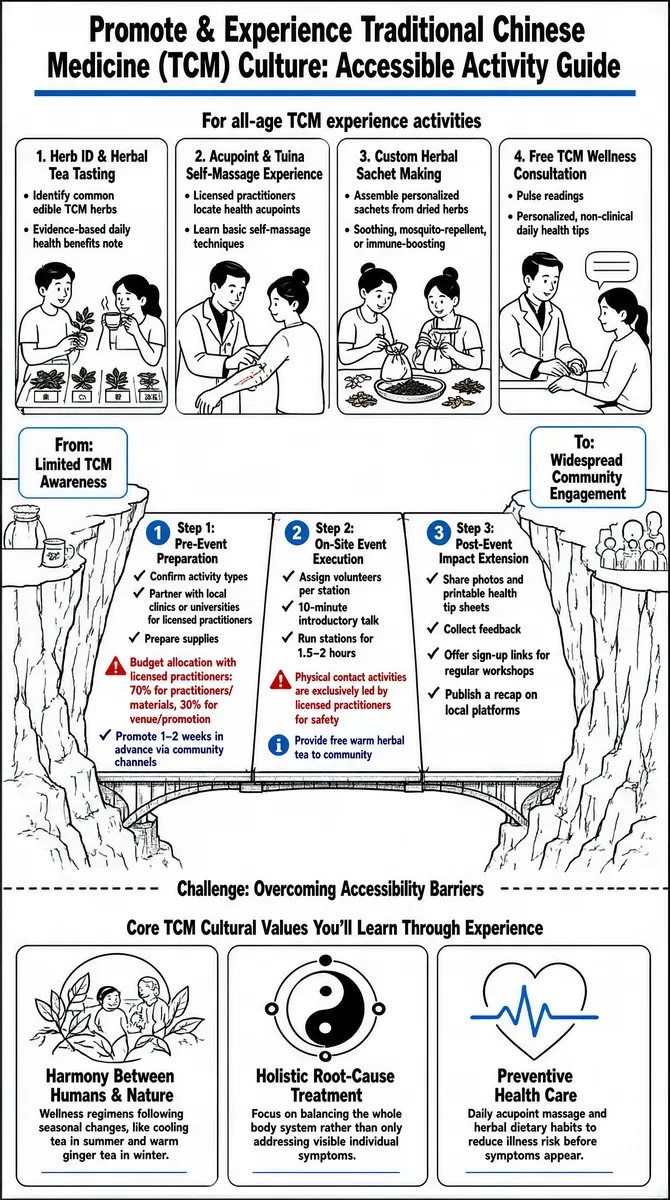
The infographic titled "Promote & Experience Traditional Chinese Medicine (TCM) Culture: Accessible Activity Guide" is designed for community events, school activities, and family workshops. It employs a clean, black-and-white line-art style with minimal color accents (blue and red) to highlight key information. The layout is structured into distinct sections, each clearly labeled and visually separated by borders and spacing. At the top, under the heading "For all-age TCM experience activities," four numbered activities are presented in a horizontal row, each accompanied by a simple illustration and bullet-point description: 1. **Herb ID & Herbal Tea Tasting**: Illustration shows two people examining herbs and drinking tea. Text states it identifies common edible TCM herbs and includes an evidence-based daily health benefits note. 2. **Acupoint & Tuina Self-Massage Experience**: Illustration depicts a practitioner assisting a participant. Text mentions licensed practitioners locate health acupoints and teach basic self-massage techniques. 3. **Custom Herbal Sachet Making**: Illustration shows two people assembling sachets from dried herbs. Text describes assembling personalized sachets for soothing, mosquito-repellent, or immune-boosting purposes. 4. **Free TCM Wellness Consultation**: Illustration shows a practitioner taking a patient’s pulse. Text lists pulse readings and personalized, non-clinical daily health tips. Below this, a central visual metaphor of a bridge spans between two cliffs labeled "From: Limited TCM Awareness" (left) and "To: Widespread Community Engagement" (right). The bridge represents the journey from awareness to engagement, divided into three steps: - **Step 1: Pre-Event Preparation** (on the left cliff): - Confirm activity types - Partner with local clinics or universities for licensed practitioners - Prepare supplies - Budget allocation with licensed practitioners: 70% for practitioners/materials, 30% for venue/promotion (highlighted in red with a warning icon) - Promote 1–2 weeks in advance via community channels - **Step 2: On-Site Event Execution** (centered on the bridge): - Assign volunteers per station - 10-minute introductory talk - Run stations for 1.5–2 hours - Red warning: Physical contact activities are exclusively led by licensed practitioners for safety - Blue note: Provide free warm herbal tea to community - **Step 3: Post-Event Impact Extension** (on the right cliff): - Share photos and printable health tip sheets - Collect feedback - Offer sign-up links for regular workshops - Publish a recap on local platforms Beneath the bridge, a dashed line separates the section titled "Challenge: Overcoming Accessibility Barriers." At the bottom, under "Core TCM Cultural Values You’ll Learn Through Experience," three values are presented with icons and descriptions: - **Harmony Between Humans & Nature** (icon: leaves and people): Wellness regimens following seasonal changes, like cooling tea in summer and warm ginger tea in winter. - **Holistic Root-Cause Treatment** (icon: yin-yang with circles): Focus on balancing the whole body system rather than only addressing visible individual symptoms. - **Preventive Health Care** (icon: heart with pulse): Daily acupoint massage and herbal dietary habits to reduce illness risk before symptoms appear. The infographic uses consistent visual elements such as circular icons for steps, checkmarks for tasks, and speech bubbles for dialogue. Color is used sparingly but effectively: blue for positive/important notes, red for warnings or critical points. All text is legible and presented in a sans-serif font, ensuring accessibility and clarity. The overall design is educational, engaging, and practical, aimed at facilitating community involvement in TCM practices.
Tags
More Images