Generate
Create images with AI
Why Plants Bend Toward Light
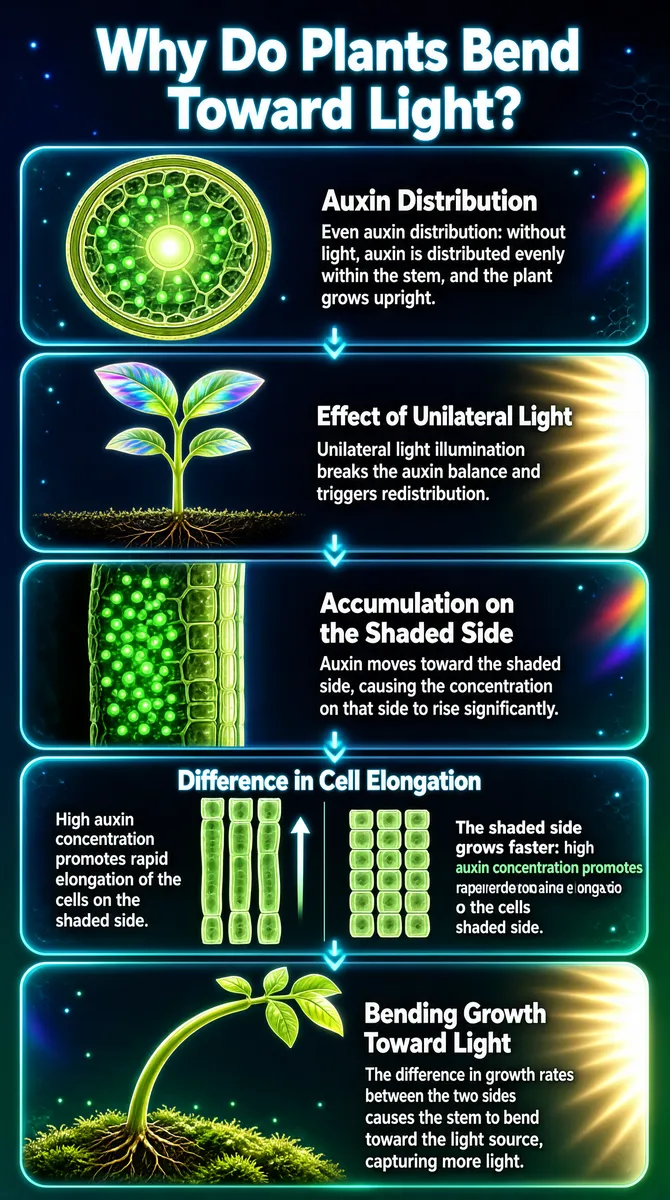
This infographic is titled "Why Do Plants Bend Toward Light?" and uses a vertical layered structure divided into five main parts, explaining the biological mechanism of plant phototropism step by step from top to bottom. The overall design is highly technological, with a deep blue-green gradient background dotted with glowing particles and rainbow halos, creating a visual atmosphere in which life science and natural phenomena blend. Each module uses a semi-transparent rounded-rectangle frame containing illustrations and explanatory text, clearly presenting each stage of the process through a combination of images and text. **Part One: Auxin Distribution** - Title: "Auxin Distribution" - Illustration: a microscopic structural diagram of a cross-section of a plant stem, with internal cells arranged in a honeycomb pattern, a bright spot in the central area, and green fluorescent particles distributed around it, symbolizing even distribution of auxin. - Text: "Even auxin distribution: without light, auxin is distributed evenly within the stem, and the plant grows upright." **Part Two: Effect of Unilateral Light** - Title: "Effect of Unilateral Light" - Illustration: a seedling under strong light from one side, with light entering from the right and the leaves reflecting an iridescent sheen, highlighting the direction of the light source. - Text: "Unilateral light illumination breaks the auxin balance and triggers redistribution." **Part Three: Accumulation on the Shaded Side** - Title: "Accumulation on the Shaded Side" - Illustration: a close-up longitudinal section of the stem, showing that the green fluorescent particles (auxin) in the cell structure clearly gather toward the left side (the shaded side). - Text: "Auxin moves toward the shaded side, causing the concentration on that side to rise significantly." **Part Four: Difference in Cell Elongation** - Title: "Difference in Cell Elongation" - Illustration: a left-right comparison; on the left are the cells of the shaded side, noticeably elongated, with an upward arrow; on the right are the cells of the light-facing side, which are shorter. - Text: - Left: "High auxin concentration promotes rapid elongation of the cells on the shaded side." - Right: "The shaded side grows faster: high auxin concentration promotes rapid elongation of the cells on the shaded side." (Note: the right-side text repeats the content of the left side but emphasizes that "the shaded side grows faster.") **Part Five: Bending Growth Toward Light** - Title: "Bending Growth Toward Light" - Illustration: a dynamic rendering of a complete seedling bending and growing to the right under light, with the stem forming an arc, the tip facing the light source, and a mossy ground at the base. - Text: "The difference in growth rates between the two sides causes the stem to bend toward the light source, capturing more light." Overall, through a five-step progressive process, this infographic systematically presents the physiological mechanism by which plants bend toward light: from initially even distribution -> unilateral light breaking the balance -> auxin transferring to the shaded side -> accelerated elongation of the cells on the shaded side -> the stem finally bending toward the light.
Tags
More Images