Generate
Create images with AI
Survival in the Abyss Deep Sea Adaptations
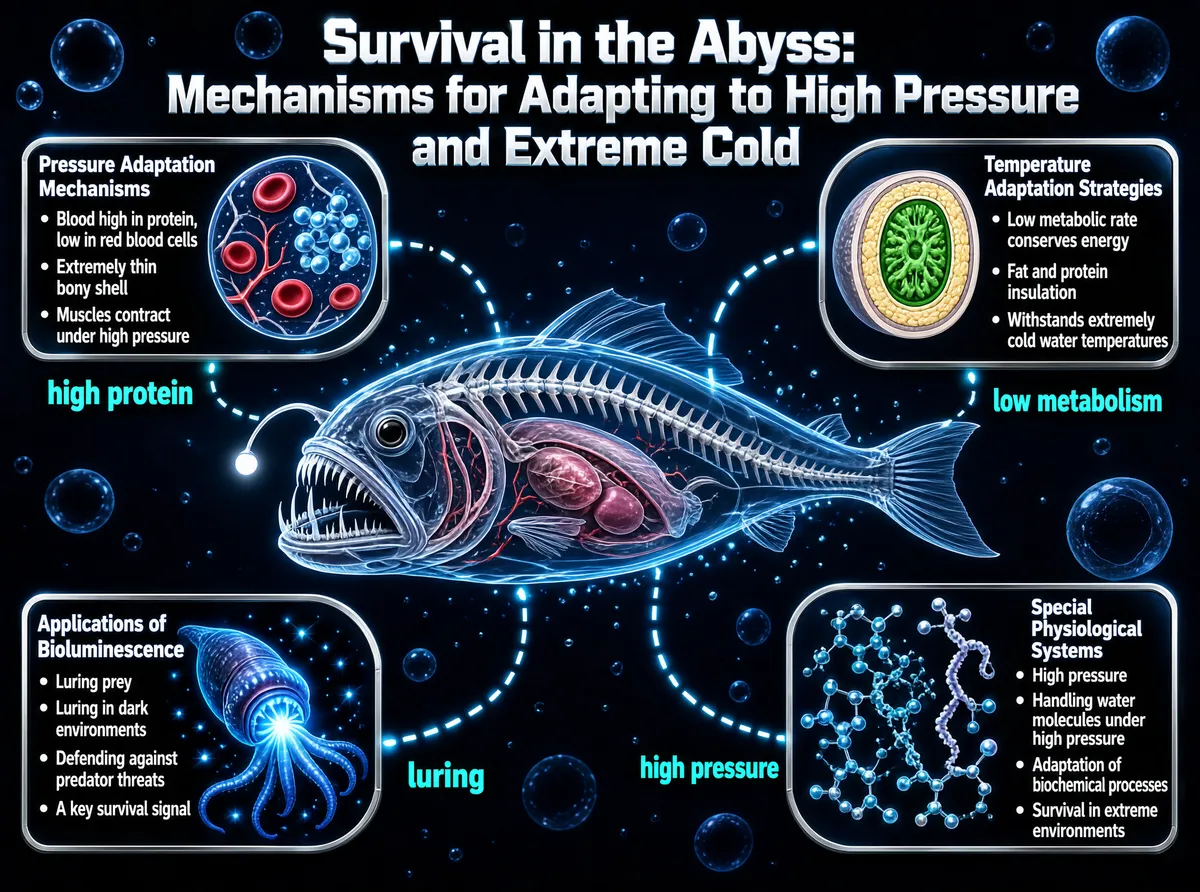
This infographic is dominated by deep blue tones, creating the dark, mysterious atmosphere of the deep sea. Its title is "Survival in the Abyss: Mechanisms for Adapting to High Pressure and Extreme Cold," rendered in silver-white three-dimensional lettering at the top center of the image, possessing a technological feel and strong visual impact. The overall layout is symmetrical, with a semi-transparent anatomical illustration of a deep-sea fish (similar to a gulper eel or deep-sea anglerfish) at the center, showing its internal skeleton and organs, surrounded by glowing particle trails that symbolize vital activity and the flow of energy. Four main modules are positioned at the upper left, upper right, lower left, and lower right; each module uses a rounded-rectangle frame with a metallic texture and a pale blue halo, and contains an illustration plus explanatory text, forming a radial structure around the central fish that emphasizes the connection between each adaptation mechanism and the core organism. The contents of the modules are as follows: 1. Upper-left module: titled "Pressure Adaptation Mechanisms," illustrated with a microscopic schematic of cells and vascular networks, showing red blood cells, plasma, and high-protein molecular structures. The text includes: - Blood high in protein, low in red blood cells - Extremely thin bony shell - Muscles contract under high pressure - Beside it, the key feature "high protein" is highlighted (in teal lettering), emphasizing the key characteristic. 2. Upper-right module: titled "Temperature Adaptation Strategies," illustrated with a cross-section schematic of the organism showing an outer layer of fatty tissue and an inner green core structure, simulating an insulating layer. The text includes: - Low metabolic rate conserves energy - Fat and protein insulation - Withstands extremely cold water temperatures - Beside it, the core strategy "low metabolism" is highlighted (in teal lettering), emphasizing the core strategy. 3. Lower-left module: titled "Applications of Bioluminescence," illustrated with a close-up of a deep-sea creature (such as a glowing fish or squid) whose mouth or tentacles emit bright blue light, with trails of light points around it. The text includes: - Luring prey - Luring in dark environments - Defending against predator threats - A key survival signal 4. Lower-right module: titled "Special Physiological Systems," illustrated with an abstract scientific illustration of molecular structures and protein chains, presenting a complex network of chemical bonds. The text includes: - High pressure - Handling water molecules under high pressure - Adaptation of biochemical processes - Survival in extreme environments In addition, around the central fish, dashed bands of light connect the four modules, pointing the four keywords "high protein," "low metabolism," "luring," and "high pressure" respectively to their corresponding modules, forming a logical closed loop. The background is scattered with large numbers of semi-transparent bubble-like or cell-like shapes, enhancing the realism and immersion of the deep-sea environment. The overall design blends scientific visualization with artistic rendering, using 3D effects, glowing elements, and cool-toned lighting to make the information both professional and appealing.
Tags
More Images