Generate
Create images with AI
Shattered Silks Deconstructed
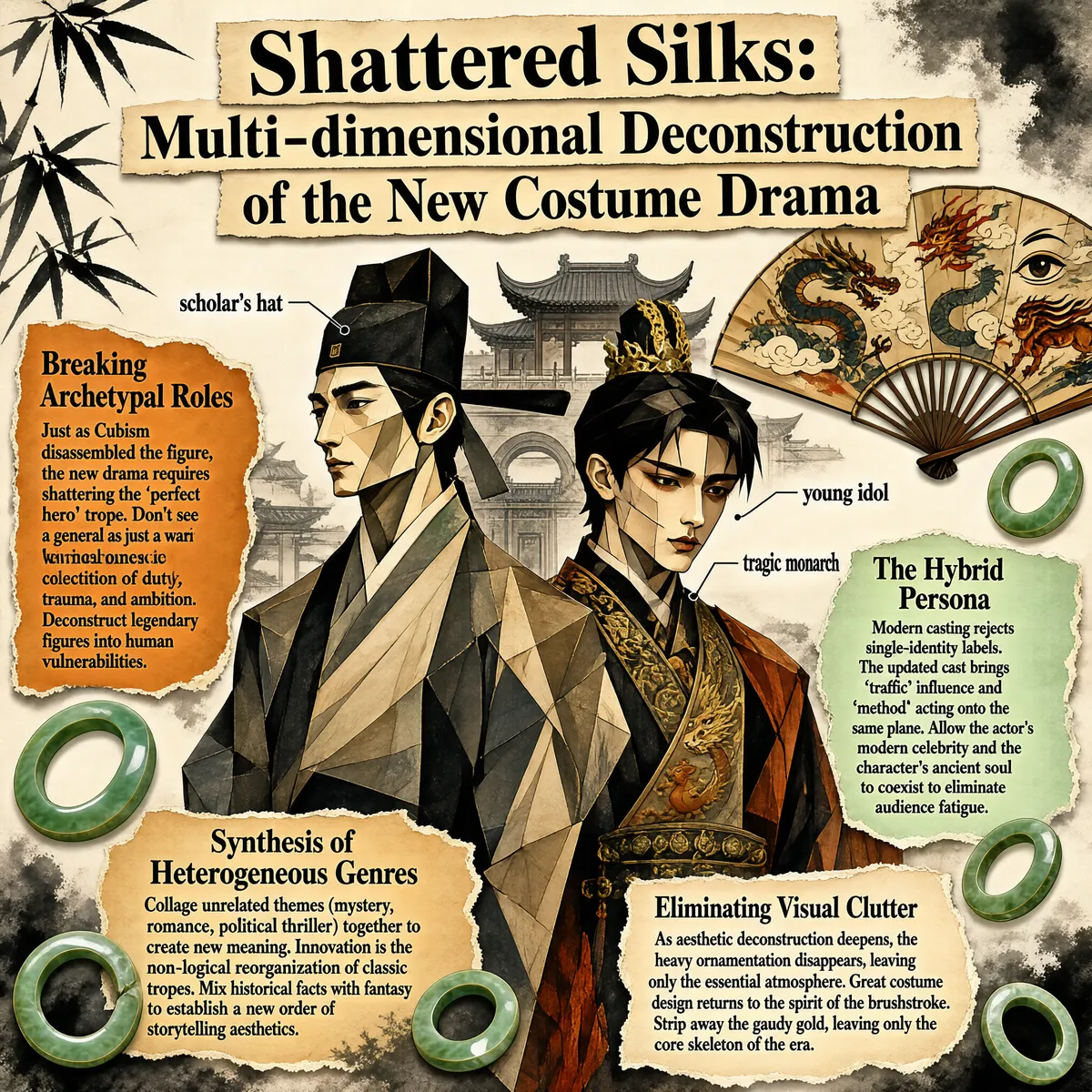
The infographic titled "Shattered Silks: Multi-dimensional Deconstruction of the New Costume Drama" presents a conceptual analysis of contemporary Chinese historical dramas using a visually rich, collage-style layout inspired by Cubism and traditional East Asian art. The title is displayed prominently at the top in a torn-paper effect with bold black serif font on beige rectangular strips, evoking a sense of fragmentation and deconstruction. The overall design blends geometric abstraction with cultural motifs such as bamboo leaves, jade rings, ink wash textures, and a traditional fan adorned with dragons and mythical creatures, creating a hybrid aesthetic that mirrors the content's theme. The central visual element features two stylized male figures rendered in a fragmented, cubist style, their faces composed of angular planes and sharp lines. The figure on the left wears a scholar’s hat (labeled "scholar's hat") and is associated with the text block "Breaking Archetypal Roles," while the figure on the right, labeled "young idol" and "tragic monarch," represents the dual identity explored in the concept of "The Hybrid Persona." These figures are set against a backdrop of a classical Chinese pavilion, further grounding the theme in historical context. The infographic is organized into five key thematic sections, each presented as a distinct text box with a unique background color and torn-edge design, positioned around the central figures: 1. **Breaking Archetypal Roles** (on an orange-brown background): - Text: "Just as Cubism disassembled the figure, the new drama requires shattering the ‘perfect hero’ trope. Don’t see a general as just a warrior; he is a geometric collection of duty, trauma, and ambition. Deconstruct legendary figures into human vulnerabilities." 2. **The Hybrid Persona** (on a pale green background): - Text: "Modern casting rejects single-identity labels. The updated cast brings ‘traffic’ influence and ‘method’ acting onto the same plane. Allow the actor’s modern celebrity and the character’s ancient soul to coexist to eliminate audience fatigue." 3. **Synthesis of Heterogeneous Genres** (on a tan background): - Text: "Collage unrelated themes (mystery, romance, political thriller) together to create new meaning. Innovation is the non-logical reorganization of classic tropes. Mix historical facts with fantasy to establish a new order of storytelling aesthetics." 4. **Eliminating Visual Clutter** (on a beige background): - Text: "As aesthetic deconstruction deepens, the heavy ornamentation disappears, leaving only the essential atmosphere. Great costume design returns to the spirit of the brushstroke. Strip away the gaudy gold, leaving only the core skeleton of the era." 5. Additional labels directly annotate the figures: - "scholar's hat" points to the left figure. - "young idol" and "tragic monarch" label the right figure. Visual elements include scattered jade rings (green, curved), stylized eyes (one fiery, one serene), and ink-wash smudges in gray-black tones, reinforcing the theme of deconstruction and artistic fusion. The fan in the upper right quadrant displays segments with traditional Chinese imagery—dragons, clouds, and animals—symbolizing the blending of myth and history. The chart type is not quantitative but conceptual, relying on qualitative textual content and symbolic imagery to convey its message. Data encoding is achieved through spatial arrangement, color coding, and direct labeling, with no numerical data present. The overall layout is asymmetrical and layered, mimicking the idea of “shattered silks” and multi-dimensional interpretation. This infographic serves as both an analytical framework and an artistic statement, arguing for a new paradigm in costume dramas—one that embraces complexity, hybridity, and minimalism over formulaic heroism and ornate spectacle. It positions modern Chinese historical drama as a dynamic, evolving form of storytelling that draws from multiple genres, psychological depth, and visual restraint.
Tags
More Images