Generate
Create images with AI
Pikachu & Global Pokémon Culture Infographic
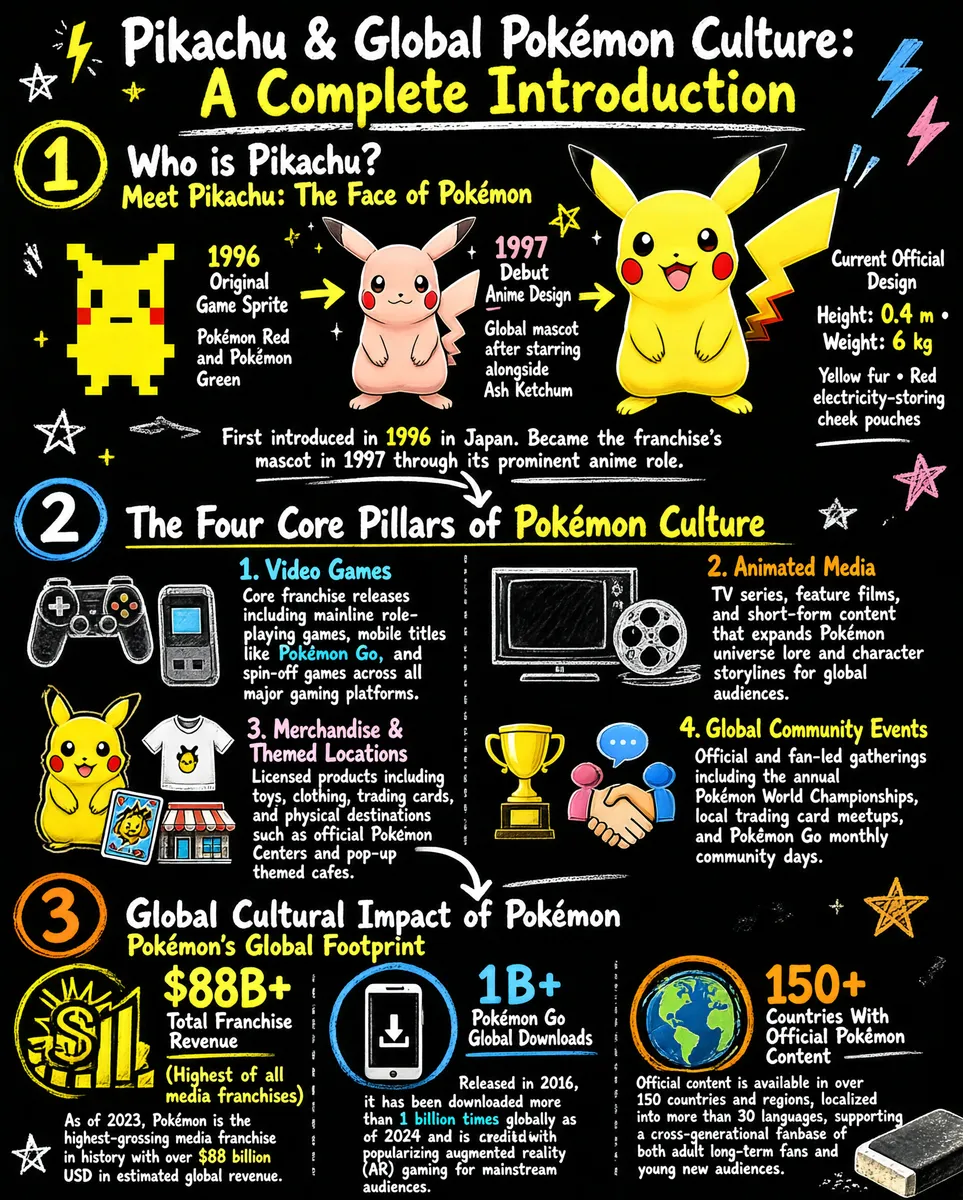
The infographic titled **"Pikachu & Global Pokémon Culture: A Complete Introduction"** is presented in a visually engaging chalkboard-style design with white, yellow, and colorful chalk-like text and illustrations on a dark background. The layout is structured into three main sections, connected by white curved arrows and numbered circles (1, 2, 3) to guide the viewer through a logical flow from introduction to cultural impact. --- ### Section 1: Who is Pikachu? – Meet Pikachu: The Face of Pokémon This section introduces Pikachu as the world’s most famous Electric-type Pokémon. It features three visual representations of Pikachu’s design evolution: - **1996 Original Game Sprite**: A pixelated, yellow, blocky version of Pikachu from the original *Pokémon Red* and *Pokémon Green* games for Nintendo Game Boy. - **1997 Debut Anime Design**: A pinkish, softer-looking Pikachu from the debut anime series, noted for being selected as the franchise’s global mascot after its lead role alongside Ash Ketchum. - **Current Official Design**: The modern, iconic yellow Pikachu with red cheek pouches and a lightning bolt-shaped tail, described with canonical stats: height of 0.4 meters, weight of 6 kilograms, yellow fur, and red electricity-storing cheek pouches. Textual content explains that Pikachu was first introduced in 1996 in Japan and became the franchise’s mascot in 1997 due to its prominent role in the anime. --- ### Section 2: The Four Core Pillars of Pokémon Culture This section outlines the foundational components of Pokémon’s global appeal, each accompanied by small illustrative icons and descriptive text: 1. **Video Games** - Icons: Game controller, handheld console, smartphone. - Description: “Core franchise releases including mainline role-playing games, mobile titles like Pokémon Go, and spin-off games across all major gaming platforms.” 2. **Animated Media** - Icons: Television, film reel. - Description: “TV series, feature films, and short-form content that expands Pokémon universe lore and character storylines for global audiences.” 3. **Merchandise & Themed Locations** - Icons: Plush toy, t-shirt, trading card, storefront. - Description: “Licensed products including toys, clothing, trading cards, and physical destinations such as official Pokémon Centers and pop-up themed cafes.” 4. **Global Community Events** - Icons: Trophy, handshake, speech bubbles with people. - Description: “Official and fan-led gatherings including the annual Pokémon World Championships, local trading card meetups, and Pokémon Go monthly community days.” --- ### Section 3: Global Cultural Impact of Pokémon – Pokémon’s Global Footprint This section presents key statistics and insights about the franchise’s worldwide influence, organized with circular icons and bold figures: - **$88B+ Total Franchise Revenue** - Subtext: “(Highest of all media franchises)” - Additional info: As of 2023, Pokémon is the highest-grossing media franchise in history with over $88 billion USD in estimated global revenue. - **1B+ Pokémon Go Global Downloads** - Additional info: Released in 2016, it has been downloaded more than 1 billion times globally as of 2024 and is credited with popularizing augmented reality (AR) gaming for mainstream audiences. - **150+ Countries With Official Pokémon Content** - Additional info: Official content is available in over 150 countries and regions, localized into more than 30 languages, supporting a cross-generational fanbase of both adult long-term fans and young new audiences. --- ### Visual Style and Layout The entire infographic mimics a chalkboard, with hand-drawn style elements including stars, lightning bolts, and sparkles around Pikachu images. Text is written in a mix of handwritten fonts and clean sans-serif styles, using white, yellow, blue, orange, and pink colors for emphasis. Arrows and numbered circles (1, 2, 3) create a clear narrative path from top to bottom. A small eraser is depicted in the bottom-right corner, reinforcing the chalkboard aesthetic. All textual content is in English, with no other languages visible. The infographic effectively combines historical context, cultural analysis, and data visualization to provide a comprehensive overview of Pikachu and the broader Pokémon phenomenon.
More Images