Generate
Create images with AI
Health Education Campaign Playbook
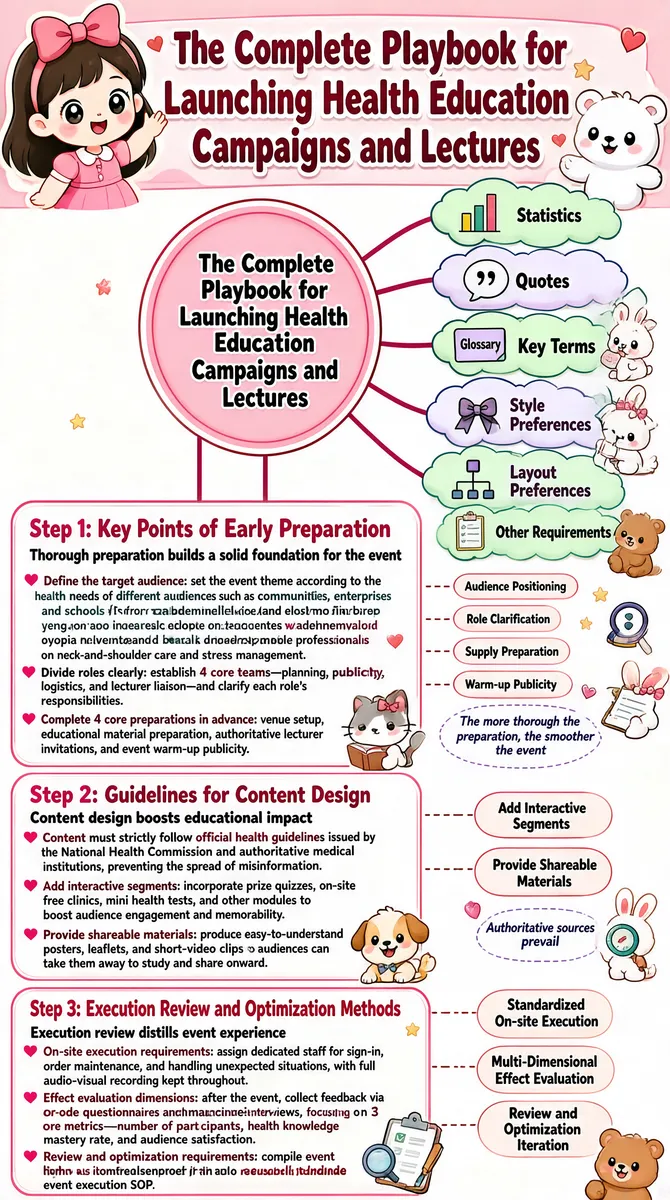
This infographic uses a pink-dominant color scheme and an adorable cartoon style, with an overall mind-map layout: the central theme sits in the central circular area, with multiple branch modules radiating outward. The title, "The Complete Playbook for Launching Health Education Campaigns and Lectures", is large and bold, decorated with stars and hearts, and a cartoon avatar sits on each side of the top (a girl with a bow on the left, a little white bear on the right), enhancing approachability. The central node is a pink circle containing the text "The Complete Playbook for Launching Health Education Campaigns and Lectures". Around it, six cloud-shaped branch modules are connected by lines, labeled "Statistics", "Quotes", "Key Terms", "Style Preferences", "Layout Preferences", and "Other Requirements", each paired with a matching small icon (such as a bar chart, quotation marks, a "Glossary" tag, a rabbit, an org chart, a list, etc.). Three main paths extend downward from the central node, representing the three steps of campaign planning: "Step 1: Key Points of Early Preparation", "Step 2: Guidelines for Content Design", and "Step 3: Execution Review and Optimization Methods". Each step is presented in a bordered rounded rectangle containing specific points, led by heart symbols and accented with related cartoon figures (cats, puppies, little bears). --- **Step 1: Key Points of Early Preparation** - **Subtitle**: "Thorough preparation builds a solid foundation for the event" - **Core points**: - Define the target audience: set the event theme according to the health needs of different audiences such as communities, enterprises, and schools—for example, middle-aged and elderly groups focus on chronic disease prevention, adolescents on myopia prevention and mental health, and workplace professionals on neck-and-shoulder care and stress management. - Divide roles clearly: establish 4 core teams—planning, publicity, logistics, and lecturer liaison—and clarify each role's responsibilities. - Complete 4 core preparations in advance: venue setup, educational material preparation, authoritative lecturer invitations, and event warm-up publicity. - **Related branches**: on the right, dashed lines connect four small ovals labeled "Audience Positioning", "Role Clarification", "Supply Preparation", and "Warm-up Publicity", with the note "The more thorough the preparation, the smoother the event". --- **Step 2: Guidelines for Content Design** - **Subtitle**: "Content design boosts educational impact" - **Core points**: - Content must strictly follow official health guidelines issued by the National Health Commission and authoritative medical institutions, preventing the spread of misinformation. - Add interactive segments: incorporate prize quizzes, on-site free clinics, mini health tests, and other modules to boost audience engagement and memorability. - Provide shareable materials: produce easy-to-understand posters, leaflets, and short-video clips so audiences can take them away to study and share onward. - **Related branches**: on the right, two small ovals are connected, labeled "Add Interactive Segments" and "Provide Shareable Materials", with the note "Authoritative sources prevail". --- **Step 3: Execution Review and Optimization Methods** - **Subtitle**: "Execution review distills event experience" - **Core points**: - On-site execution requirements: assign dedicated staff for sign-in, order maintenance, and handling unexpected situations, with full audio-visual recording kept throughout. - Effect evaluation dimensions: after the event, collect feedback via QR-code questionnaires and machine interviews, focusing on 3 core metrics—number of participants, health knowledge mastery rate, and audience satisfaction. - Review and optimization requirements: compile event highlights and items for improvement into a reusable, standardized event execution SOP. - **Related branches**: on the right, three small ovals are connected, labeled "Standardized On-site Execution", "Multi-Dimensional Effect Evaluation", and "Review and Optimization Iteration". --- **Right-Side Panel: Six Supporting Elements** The six cloud modules around the central theme, from top to bottom, are: 1. **(Statistics)** (light green cloud, containing bar chart and pie chart icons) 2. **(Quotes)** (light green cloud, containing a double-quotation-mark speech bubble icon) 3. **(Key Terms)** (light purple cloud, containing a "Glossary" tag icon) 4. **(Style Preferences)** (light purple cloud, containing a rabbit-with-bow icon) 5. **(Layout Preferences)** (light green cloud, containing a tree-shaped org chart icon) 6. **(Other Requirements)** (light purple cloud, containing a list icon) These modules are connected to the central node with solid lines, indicating that they are supplementary factors or design reference dimensions to consider during campaign planning. --- **Visual Elements Summary**: - Main colors: soft pink, light purple, and light green, creating a warm, friendly atmosphere. - Icons: extensive use of cute cartoon animals (cats, dogs, bears, rabbits), stars, hearts, clipboards, speech bubbles, etc., enhancing fun and readability. - Fonts: titles use a bold rounded typeface; body text uses a clear, readable sans-serif font, with some keywords bolded or color-highlighted. - Layout: combines a mind map with a step-by-step process, logically clear and well layered, suitable for quick browsing and information extraction. The infographic fully presents a standardized end-to-end operating guide for health education campaigns—from preparation and design to execution review—balancing professionalism with accessibility, and is suitable for planning health education projects in communities, enterprises, schools, and similar settings.
Tags
More Images