Generate
Create images with AI
Diet & Cancer Risk: Your Scientific Prevention Guide
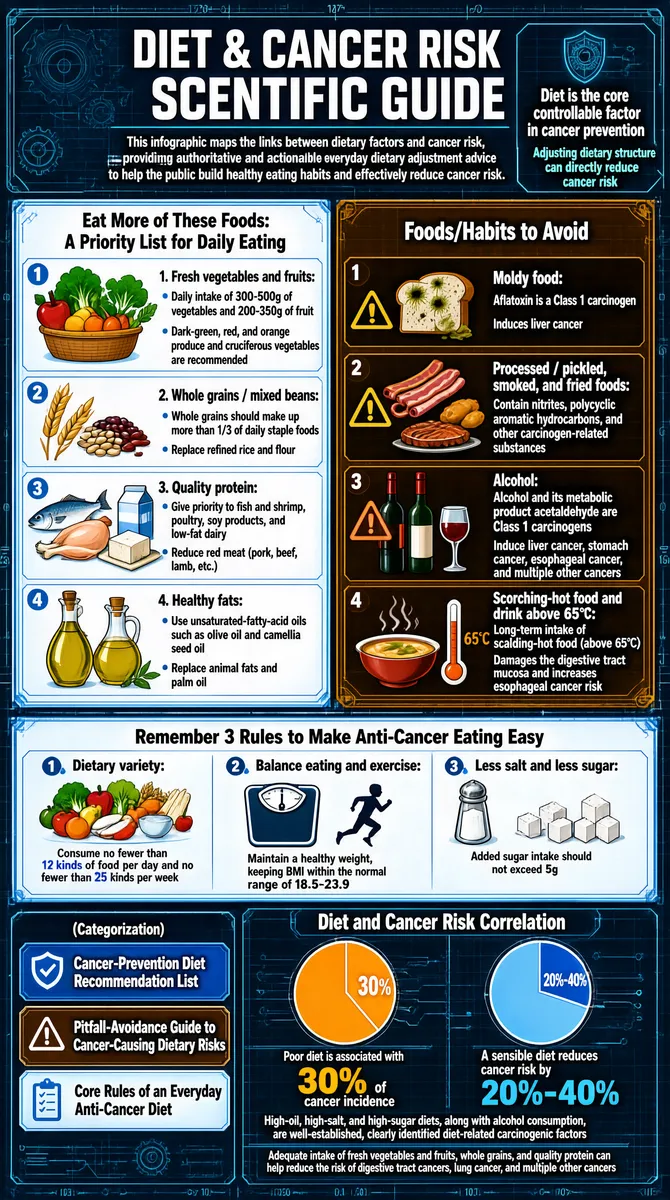
This infographic is titled "DIET & CANCER RISK SCENTIFIC GUIDE", designed in a deep-blue tech blueprint style with a clear overall layout and well-defined structure, presenting content through modular sections. The background features grid lines and mechanical gears and other engineering elements, creating a rigorous, authoritative scientific atmosphere. The main title at the top uses bold white lettering, with a subtitle below: "This infographic maps the links between dietary factors and cancer risk, providing authoritative and actionable everyday dietary adjustment advice to help the public build healthy eating habits and effectively reduce cancer risk." On the right, the annotations "Diet is the core controllable factor in cancer prevention" and "Adjusting dietary structure can directly reduce cancer risk" reinforce the core message. The main body of the infographic is divided into three major sections, distinguished by different colors and icons: I. Cancer-Prevention Diet Recommendation List (light blue module) This section is titled "Eat More of These Foods: A Priority List for Daily Eating" and contains four recommended categories: 1. Fresh vegetables and fruits: - Daily intake of 300-500g of vegetables and 200-350g of fruit - Dark-green, red, and orange produce and cruciferous vegetables are recommended - Illustration: line drawing of a basket filled with vegetables and fruits 2. Whole grains / mixed beans: - Whole grains should make up more than 1/3 of daily staple foods - Replace refined rice and flour - Illustration: line drawings of wheat ears, a bowl of grains, and beans 3. Quality protein: - Give priority to fish and shrimp, poultry, soy products, and low-fat dairy - Reduce red meat (pork, beef, lamb, etc.) - Illustration: line drawings of fish, chicken, a milk carton, and tofu 4. Healthy fats: - Use unsaturated-fatty-acid oils such as olive oil and camellia seed oil - Replace animal fats and palm oil - Illustration: line drawings of oil bottles and an oil cruet II. Pitfall-Avoidance Guide to Cancer-Causing Dietary Risks (brown module) This section is titled "Foods/Habits to Avoid" and contains four risk points to steer clear of: 1. Moldy food: - Aflatoxin is a Class 1 carcinogen - Induces liver cancer - Illustration: moldy bread and a warning triangle icon 2. Processed / pickled, smoked, and fried foods: - Contain nitrites, polycyclic aromatic hydrocarbons, and other carcinogen-related substances - Illustration: line drawings of bacon, sausage, fried chicken drumsticks, and grilled meat 3. Alcohol: - Alcohol and its metabolic product acetaldehyde are Class 1 carcinogens - Induce liver cancer, stomach cancer, esophageal cancer, and multiple other cancers - Illustration: wine bottles, wine glasses, and a warning triangle icon 4. Scorching-hot food and drink above 65°C: - Long-term intake of scalding-hot food (above 65°C) - Damages the digestive tract mucosa and increases esophageal cancer risk - Illustration: a bowl of hot soup and a thermometer showing high temperature III. Core Rules of an Everyday Anti-Cancer Diet (light blue module) This section is titled "Remember 3 Rules to Make Anti-Cancer Eating Easy" and contains three core principles: 1. Dietary variety: - Consume no fewer than 12 kinds of food per day and no fewer than 25 kinds per week - Illustration: line drawings of various fruits, vegetables, meats, grains, and other foods 2. Balance eating and exercise: - Maintain a healthy weight, keeping BMI within the normal range of 18.5-23.9 - Illustration: a weighing scale and a running human-figure icon 3. Less salt and less sugar: - Daily salt intake should not exceed 5g - Added sugar intake should not exceed 25g - Illustration: line drawings of a salt shaker and sugar cubes The bottom area further summarizes key data and correlations: On the left is a small "(Categorization)" module using three box diagrams corresponding to the three major sections above: a blue box representing the "Cancer-Prevention Diet Recommendation List", a brown box representing the "Pitfall-Avoidance Guide to Cancer-Causing Dietary Risks", and a light blue box representing the "Core Rules of an Everyday Anti-Cancer Diet". On the right is the "Diet and Cancer Risk Correlation" module, containing two circular pie charts with explanatory text: - The left pie chart shows "Poor diet is associated with 30% of cancer incidence", with an orange-yellow progress bar - The right pie chart shows "A sensible diet reduces cancer risk by 20%-40%", with a blue progress bar - Explanatory text: - High-oil, high-salt, and high-sugar diets, along with alcohol consumption, are well-established, clearly identified diet-related carcinogenic factors - Adequate intake of fresh vegetables and fruits, whole grains, and quality protein can help reduce the risk of digestive tract cancers, lung cancer, and multiple other cancers Through its clear visual hierarchy, consistent icon style, precise numerical annotations, and logically distinct module divisions, the infographic systematically communicates the scientific relationship between diet and cancer risk, combining educational value with practicality.
Tags
More Images