Generate
Create images with AI
Desert Root Systems Underground Survival
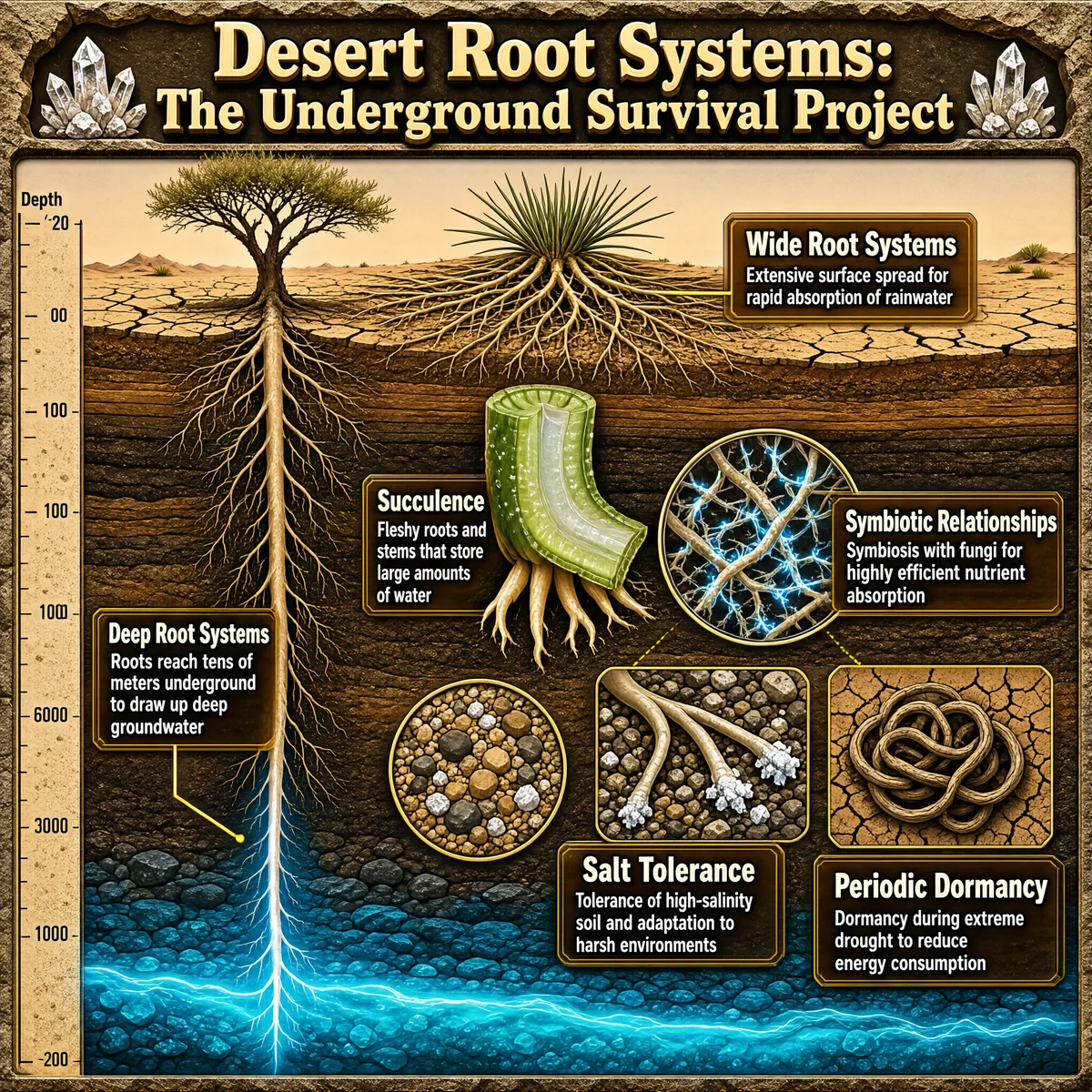
This infographic is titled "Desert Root Systems: The Underground Survival Project." In the form of a cross-sectional cutaway view, it vividly shows how desert plant root systems survive in extremely arid and barren environments through a variety of physiological and ecological adaptation mechanisms. The overall design uses a sandy-textured background and rock-textured borders to create an authentic desert atmosphere. The title at the top is rendered in 3D embossed lettering, flanked by crystal-cluster ornaments for added visual impact. A glowing blue arrow runs horizontally beneath the title, symbolizing the direction of water or energy flow. The main body of the image is a vertical geological cross-section extending from the dry, cracked surface down to the deep groundwater layer. The surface shows the typically parched, fissured soil of a desert in brownish-yellow tones; the underground strata are clearly layered, comprising a shallow dry soil layer, a middle aquifer, and the glowing blue deep groundwater at the bottom. A vertical scale is placed along the left edge to indicate depth, though no specific numeric units are labeled. Through six annotated callout boxes with illustrations, the image systematically introduces six survival strategies of plant root systems; each strategy comes with a close-up illustration and explanatory text: 1. **Deep Root Systems** - Illustration: A tree whose roots plunge vertically deep underground, reaching the glowing blue deep groundwater. - Explanatory text: "Roots reach tens of meters underground to draw up deep groundwater" - Position: On the left side of the image, just above the deep groundwater layer. 2. **Wide Root Systems** - Illustration: Roots spreading extensively and horizontally just beneath the surface, forming a dense network structure. - Explanatory text: "Extensive surface spread for rapid absorption of rainwater" - Position: To the right of the deep root system, within the shallow soil zone. 3. **Succulence** - Illustration: A cut-open stem showing a green, juicy interior with crystalline granules on the surface. - Explanatory text: "Fleshy roots and stems that store large amounts of water" - Position: To the right of the wide root system, near the middle soil layer. 4. **Symbiotic Relationships** - Illustration: A microscopic view of roots interwoven with fungal networks, emitting a blue-white fluorescence and showing dynamic interaction. - Explanatory text: "Symbiosis with fungi for highly efficient nutrient absorption" - Position: To the right of the succulence box, in the middle soil zone. 5. **Salt Tolerance** - Illustration: Root tips coated with white salt crystals, surrounded by scattered gravel. - Explanatory text: "Tolerance of high-salinity soil and adaptation to harsh environments" - Position: Below the symbiosis box, near the middle soil layer. 6. **Periodic Dormancy** - Illustration: Roots coiled within cracked soil, shrunken in form, exhibiting a dormant state. - Explanatory text: "Dormancy during extreme drought to reduce energy consumption" - Position: To the right of the salt-tolerance box, likewise in the middle soil zone. In addition, below the symbiosis box there is a small circular inset showing a soil sample mixed with gravels of varying sizes and sand grains, presumably to emphasize the influence of soil texture on root systems. All callout boxes share a uniform semi-transparent brown border design, embedding illustrations and text, and are connected by thin yellow or white lines to the corresponding root structures, achieving precise image-text correspondence. The overall layout is logically clear, guiding the eye from left to right and top to bottom, progressing layer by layer from macro to micro and from water acquisition to physiological adaptation, comprehensively revealing the complex engineering system of underground survival in desert plants.
Tags
More Images






![[Format] Landscape 16:9 gig cover, bold dark vector promo la](https://files.posterlet.com/assets/generated/md/ntsl0qmzxxt7.webp)