Generate
Create images with AI
Civil Case Withdrawal Ruling Guide
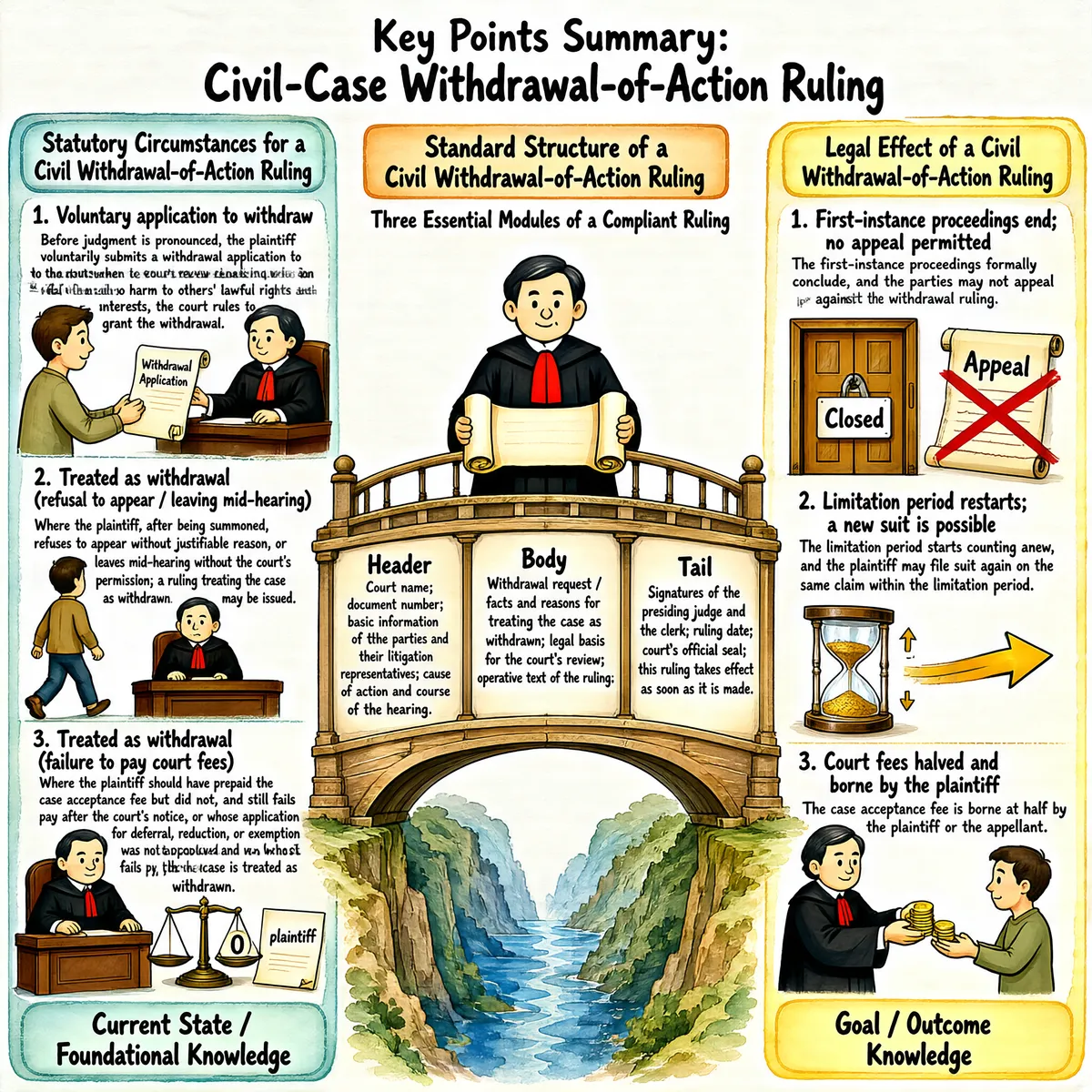
This infographic is titled "Key Points Summary: Civil-Case Withdrawal-of-Action Ruling," rendered in a hand-drawn watercolor style. Its overall layout is symmetrical, with an arch bridge spanning a gorge as the visual center, symbolizing the bridge that connects "current state / foundational knowledge" with "goal / outcome knowledge." Beneath the bridge lies a gorge rendered in blue watercolor, representing "the gap in normative understanding between applicable scenarios and legal effect," emphasizing the linking and deepening of the knowledge system. The infographic's content is divided into three major sections — left, center, and right — distinguished by differently colored title boxes: I. Left Section: "Statutory Circumstances for a Civil Withdrawal-of-Action Ruling" (light blue-green background) This section explains that only three types of circumstances allow a withdrawal-of-action ruling to be issued, covering three specific situations, each with an illustration and explanatory text: 1. Voluntary application to withdraw: - Illustration: the plaintiff holds a "Withdrawal Application" scroll and submits it to the judge. - Text: "Before judgment is pronounced, the plaintiff voluntarily submits a withdrawal application to the court; where the court's review finds no violation of law and no harm to others' lawful rights and interests, the court rules to grant the withdrawal." 2. Treated as withdrawal (refusal to appear / leaving mid-hearing): - Illustration: the plaintiff walks away with their back to the courtroom while the judge sits on the bench. - Text: "Where the plaintiff, after being summoned, refuses to appear without justifiable reason, or leaves mid-hearing without the court's permission, a ruling treating the case as withdrawn may be issued." 3. Treated as withdrawal (failure to pay court fees): - Illustration: the scale before the judge reads "0," with a "plaintiff" document beside it. - Text: "Where the plaintiff should have prepaid the case acceptance fee but did not, and still fails to pay after the court's notice, or whose application for deferral, reduction, or exemption was not approved and who still fails to pay, the case is treated as withdrawn." - Bottom label: "Current State / Foundational Knowledge" II. Center Section: "Standard Structure of a Civil Withdrawal-of-Action Ruling" (light orange background) This section uses the bridge structure to display the ruling document's three major modules, with a judge figure at the center holding a scroll, flanked on each side by the "Header," "Body," and "Tail" content: - Header: - Must state the court's name, the document number, the basic information of the parties and their litigation representatives, and the cause of action and course of the hearing. - Body: - Must state the withdrawal request / the facts and reasons for treating the case as withdrawn, the legal basis for the court's review, and the operative text of the ruling. - Tail: - Must bear the signatures of the presiding judge and the clerk, the ruling date, and the court's official seal, along with the statutory statement that "this ruling takes effect as soon as it is made." - Noted beneath the title: "Three Essential Modules of a Compliant Ruling" III. Right Section: "Legal Effect of a Civil Withdrawal-of-Action Ruling" (light yellow background) This section explains the three statutory effects that arise once the ruling takes force, each with an illustration and explanation: 1. First-instance proceedings end; no appeal permitted: - Illustration: a door with a "Closed" sign, next to an "Appeal" scroll crossed out with a red X. - Text: "The first-instance proceedings formally conclude, and the parties may not appeal against the withdrawal ruling." 2. Limitation period restarts; a new suit is possible: - Illustration: an hourglass turning over, an arrow pointing to a fresh starting point. - Text: "The limitation period starts counting anew, and the plaintiff may file suit again on the same claim within the limitation period." 3. Court fees halved and borne by the plaintiff: - Illustration: the judge hands gold coins to the plaintiff. - Text: "The case acceptance fee is borne at half by the plaintiff or the appellant." - Bottom label: "Goal / Outcome Knowledge" The overall design uses soft watercolor brushwork with simple, cartoon-like figures; the palette is dominated by off-white, light brown, light green, and light orange, creating a professional yet easy-to-read visual atmosphere. All text is in English, and the content fully covers the entire workflow of a civil withdrawal-of-action ruling, from applicable conditions and document structure to legal consequences.
Tags
More Images