Generate
Create images with AI
Aerodynamics of Human Body Rotation
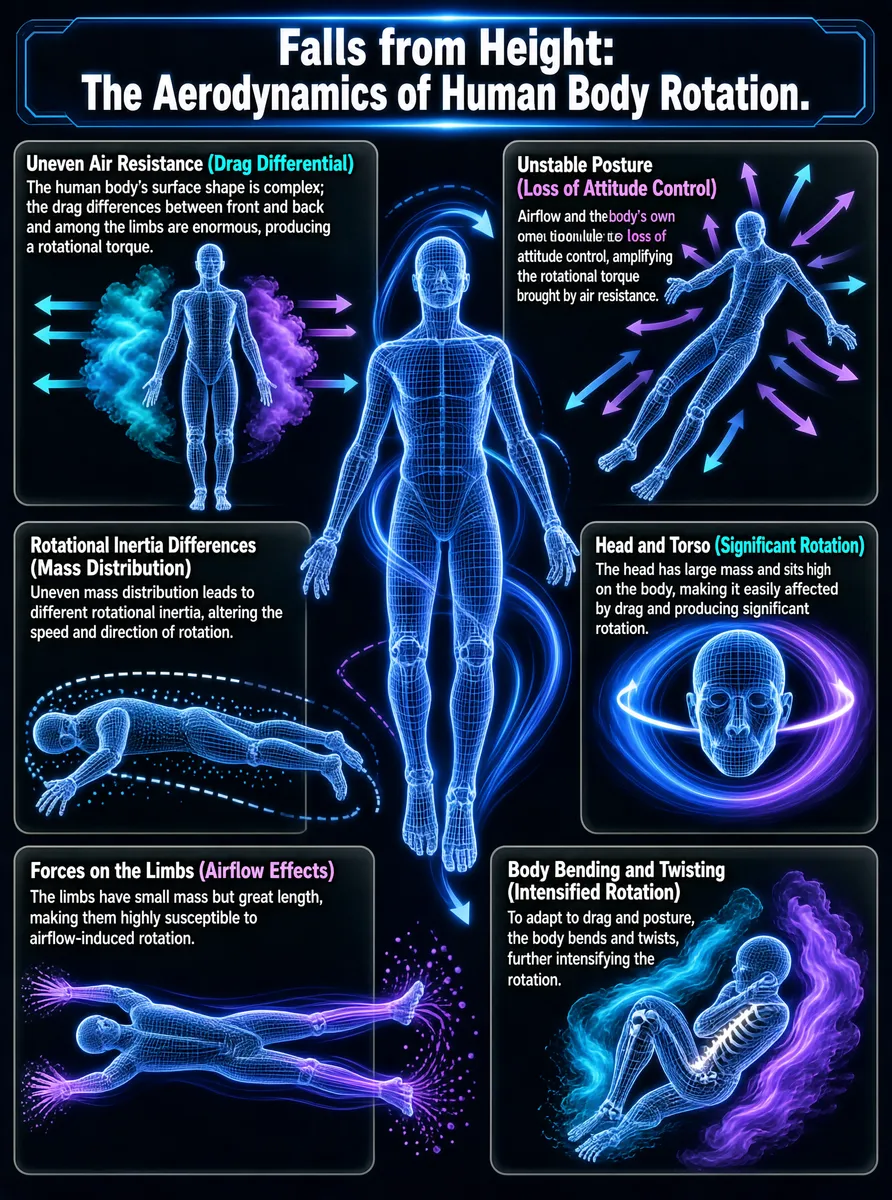
This infographic is titled "Falls from Height: The Aerodynamics of Human Body Rotation." Presented against a deep-blue tech-style background, its overall layout is a vertically layered structure built around a central human wireframe model, unfolding six core explanatory modules. Each module contains a bordered explanatory text box and a corresponding visualized diagram of the body in motion, using a blue-purple wireframe human figure with flowing airflow lines, supplemented by arrows, vortex light effects, and particle trails to vividly depict the aerodynamic effects. The title sits at the top center in large, white bold lettering with a glowing effect, clearly highlighting the theme. The six modules are arranged from top to bottom in a left-right symmetrical distribution, three modules per side, forming a balanced composition: 1. **Uneven Air Resistance (Drag Differential)** - Position: upper-left corner - Text content: "The human body's surface shape is complex; the drag differences between front and back and among the limbs are enormous, producing a rotational torque." - Visual elements: A front-facing wireframe of the human body with cyan and purple cloud-like airflow disturbances on either side, representing the front/rear drag differential; multiple colored arrows point to different parts of the body, indicating airflow direction and pressure distribution. 2. **Unstable Posture (Loss of Attitude Control)** - Position: upper-right corner - Text content: "Airflow and the body's own motion lead to loss of attitude control, amplifying the rotational torque brought by air resistance." - Visual elements: Multi-directional arrows surround the human wireframe, representing the interaction between turbulent airflow and body movement and conveying the state of postural imbalance. 3. **Rotational Inertia Differences (Mass Distribution)** - Position: middle-left - Text content: "Uneven mass distribution leads to different rotational inertia, altering the speed and direction of rotation." - Visual elements: The human body in a prone rotating posture, rendered as a dot matrix, with a spiral dashed trajectory across the back symbolizing the rotation path and changing inertia. 4. **Head and Torso (Significant Rotation)** - Position: middle-right - Text content: "The head has large mass and sits high on the body, making it easily affected by drag and producing significant rotation." - Visual elements: A close-up wireframe of the head surrounded by a bright blue-purple dual-color vortex halo, emphasizing the dynamic effect of the head as a rotation center. 5. **Forces on the Limbs (Airflow Effects)** - Position: lower-left - Text content: "The limbs have small mass but great length, making them highly susceptible to airflow-induced rotation." - Visual elements: The human body in a supine, outstretched posture with elongated limbs; purple airflow lines flow along the limbs and particle diffusion occurs at their ends, showing the sensitivity of long limbs to airflow. 6. **Body Bending and Twisting (Intensified Rotation)** - Position: lower-right - Text content: "To adapt to drag and posture, the body bends and twists, further intensifying the rotation." - Visual elements: The human body in a curled, twisted posture with cyan and purple cloud-like airflows on its front and back sides, accompanied by a glowing skeletal structure, depicting the body deforming in response to air resistance. All text boxes are semi-transparent dark-gray rounded rectangles containing white text; key terms are highlighted with colored labels (for example, "drag differential" in cyan, "loss of attitude control" in purple, "mass distribution" in gray-white, "significant rotation" in cyan, "airflow effects" in purple, and "intensified rotation" in gray-white), enhancing information hierarchy and readability. The overall style is modern and strongly tech-oriented, combining 3D wireframe modeling, dynamic airflow visualization, and physical mechanics concepts to systematically explain the multiple mechanisms by which the human body begins to rotate under aerodynamic forces during a fall from height, making it suitable for popular-science education or safety-protection research contexts.
More Images