Generate
Create images with AI
A Guide to Forming Good Habits
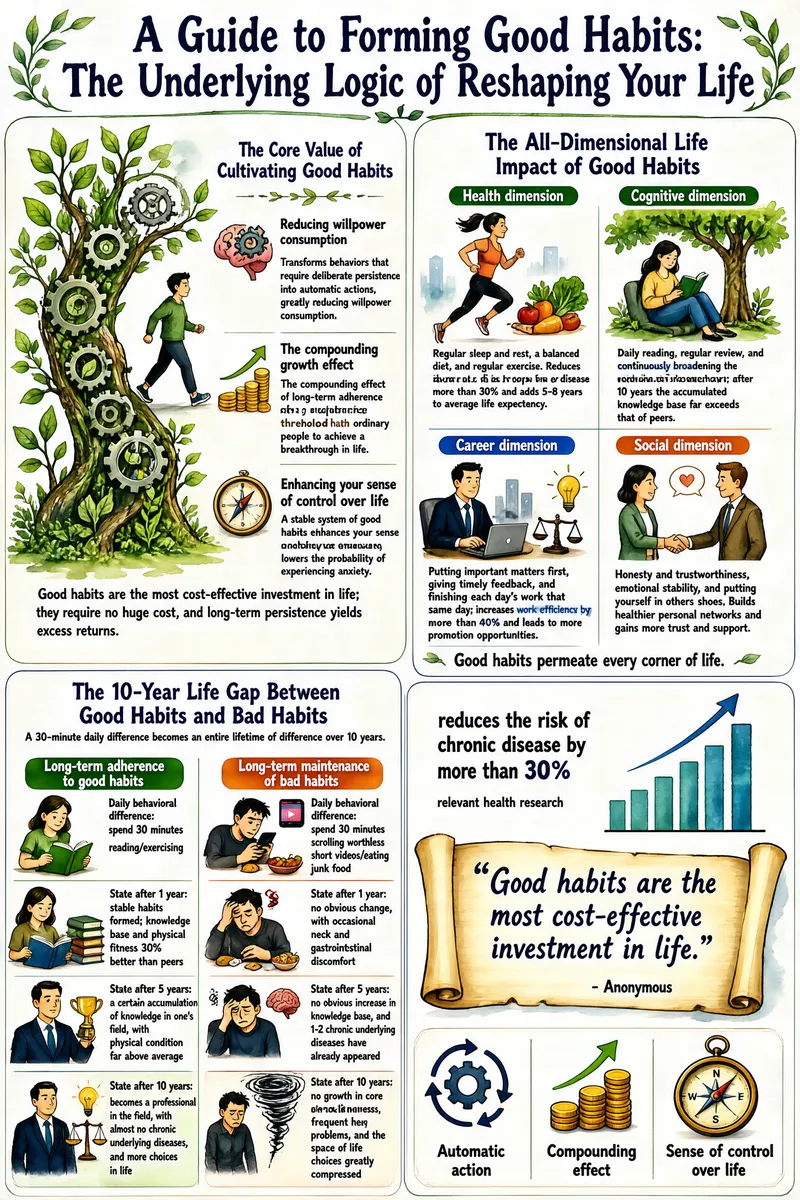
This infographic is themed "A Guide to Forming Good Habits: The Underlying Logic of Reshaping Your Life," using a soft watercolor-style background. The overall layout is a four-quadrant structure, with content divided into four main sections, supplemented by illustrations and icons to enhance readability. The main title is centered at the top in a fairly large dark blue font and serves as a guide. Section One: "The Core Value of Cultivating Good Habits," located in the upper left. It is accompanied by an illustration depicting a person walking along a tree trunk made of gears and plants, symbolizing the automation and growth of habits. Below, three core value points are each explained with an icon and text: - Reducing willpower consumption: the icon is a brain and gears; the text explains, "Transforms behaviors that require deliberate persistence into automatic actions, greatly reducing willpower consumption." - The compounding growth effect: the icon is coins and an upward arrow; the text states, "The compounding effect of long-term adherence to good habits is the lowest-threshold path for ordinary people to achieve a breakthrough in life." - Enhancing your sense of control over life: the icon is a compass; the text states, "A stable system of good habits enhances your sense of control over life and lowers the probability of experiencing anxiety." Bottom summary sentence: "Good habits are the most cost-effective investment in life; they require no huge cost, and long-term persistence yields excess returns." Section Two: "The All-Dimensional Life Impact of Good Habits," located in the upper right. It contains four sub-dimensions, each with an illustration and explanatory text: - Health dimension (green label): illustration of a woman running with fruits and vegetables; text: "Regular sleep and rest, a balanced diet, and regular exercise. Reduces the risk of chronic disease by more than 30% and adds 5-8 years to average life expectancy." - Cognitive dimension (green label): illustration of a woman reading under a tree; text: "Daily reading, regular review, and continuously broadening the boundaries of cognition; after 10 years the accumulated knowledge base far exceeds that of peers." - Career dimension (blue label): illustration of a man working in an office; text: "Putting important matters first, giving timely feedback, and finishing each day's work that same day; increases work efficiency by more than 40% and leads to more promotion opportunities." - Social dimension (orange label): illustration of two people shaking hands and talking; text: "Honesty and trustworthiness, emotional stability, and putting yourself in others' shoes. Builds healthier personal networks and gains more trust and support." Bottom summary sentence: "Good habits permeate every corner of life." Section Three: "The 10-Year Life Gap Between Good Habits and Bad Habits," located in the lower left. The theme sentence is "A 30-minute daily difference becomes an entire lifetime of difference over 10 years." It is divided into a left-right comparison: - Left column, "Long-term adherence to good habits": - Daily behavioral difference: spend 30 minutes reading/exercising (illustration of a woman reading) - State after 1 year: stable habits formed; knowledge base and physical fitness 30% better than peers (illustration of a woman reading with a stack of books) - State after 5 years: a certain accumulation of knowledge in one's field, with physical condition far above average (illustration of a man in a suit with a trophy) - State after 10 years: becomes a professional in the field, with almost no chronic underlying diseases, and more choices in life (illustration of a man in a suit with a scale and a light bulb) - Right column, "Long-term maintenance of bad habits": - Daily behavioral difference: spend 30 minutes scrolling worthless short videos/eating junk food (illustration of a man looking at a phone with snacks) - State after 1 year: no obvious change, with occasional neck and gastrointestinal discomfort (illustration of a man with a headache) - State after 5 years: no obvious increase in knowledge base, and 1-2 chronic underlying diseases have already appeared (illustration of a man with a headache and a brain icon) - State after 10 years: no growth in core competitiveness, frequent health problems, and the space of life choices greatly compressed (illustration of a man in agony with a tornado) Section Four: located in the lower right, containing three sub-parts: - Statistical data: a bar chart shows "reduces the risk of chronic disease by more than 30%," with no ticks on the X-axis and an upward-trend arrow on the Y-axis, with the data source noted as "relevant health research." - Quoted saying: in a scroll style, "Good habits are the most cost-effective investment in life." - Anonymous - Key terms: three icon-and-text combinations: - Automatic action (gear-cycle icon) - Compounding effect (growing-coins icon) - Sense of control over life (compass icon) The entire infographic uses a large number of hand-drawn-style illustrations with fresh, natural colors; the main palette is blue, green, and creamy white, with a clear visual hierarchy and a lucid information structure, aiming to emphasize the profound impact of good habits on personal development through multi-dimensional comparison and data support.
More Images